

What a narrative is, and what makes it work
A narrative is a story written to entertain a reader and make them feel something. It has characters in a setting, a problem that gets in their way, and events told in an order the reader can follow to an ending. In NAPLAN, a narrative is marked on ten criteria, from how it holds its reader to how its words are spelled.
Most of what makes a story work can be taught as a handful of decisions. A young writer rarely needs a bigger plot. They need to make a few things happen on the page.
- Someone who wants something. A character with a goal gives the reader a reason to keep reading. Even a short scene needs one: in our free narrative lesson, Maya wants to plant her last seed before the rain comes.
- Something in the way. The complication makes the goal harder to reach. It’s where most of the story’s feeling lives, so it deserves the most words.
- A choice that changes things. The character does something about the problem. An ending that follows from that action feels earned. An ending that arrives from nowhere (“and then I woke up”) undoes the story.
- People and places a reader can see. Not a list of names, but a few details chosen because they matter to this story.
- A reader in mind. The writer tells the reader who, where and when, lets them feel what the character feels, and leaves them with something at the end.
The usual shape is an orientation, a complication and a resolution. Teach it as a shape rather than a formula. In the marking guide’s own samples, a story that ends by waking from a dream is marked lower for text structure than one that doesn’t conclude at all: an ending doesn’t have to tie everything up, but it has to belong to the story.
How NAPLAN marks a narrative: the ten criteria
NAPLAN marks a narrative on ten criteria, each on its own scale starting at 0, for 47 marks in all. Roughly, four look at the story as a whole (audience, text structure, ideas, and character and setting), three at how it’s put together (vocabulary, cohesion and paragraphing), and three at the conventions of written English (sentence structure, punctuation and spelling).
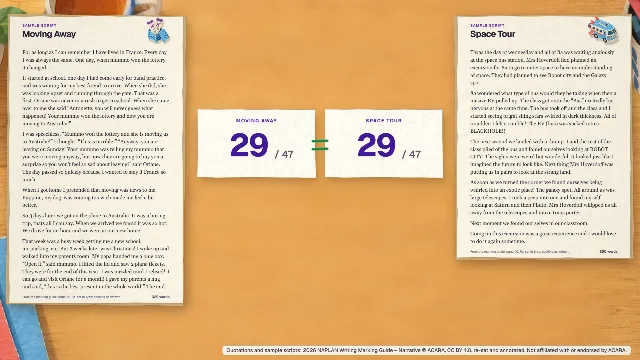
There is no criterion for length, and a story’s total says less than its ten scores. In the first film of our free course, two stories from the marking guide each score 29 out of 47, by quite different routes.
| Criterion | What it looks for | Marks |
|---|---|---|
| Audience | How well the story orients, engages and affects its reader: would a stranger know who, where and when, and what should the reader feel at the end? | 0–6 |
| Text structure | How the story is shaped through orientation, complication and resolution, and how it gets from its worst moment to its last line. | 0–4 |
| Ideas | How well the ideas are chosen and elaborated. One idea explored from the inside counts for more than many ideas passed through. | 0–5 |
| Character and setting | Whether people and places are only named, suggested, or emerge from detail the writer has selected. | 0–4 |
| Vocabulary | Low on the scale, how many precise words there are; higher up, what the words are doing in this story. | 0–5 |
| Cohesion | How the story holds together, so a reader following one thing from the first line to the last never has to go back up the page. | 0–4 |
| Paragraphing | Whether the breaks are random, appropriate or deliberate. A change of time or place usually calls for one. | 0–2 |
| Sentence structure | Are the sentences right, how are they built, and what are they doing? Correct but repetitive sentences only go so far. | 0–6 |
| Punctuation | Sentence punctuation first, then everything else. With too many full stops missing, the score can’t go above 2. | 0–5 |
| Spelling | The accuracy of the spelling and the difficulty of the words attempted. It isn’t a count of mistakes. | 0–6 |
These are our plain-English summaries, written to match the films in Inside the marking guide, our free course on the 2026 narrative marking guide: one short film for each criterion, told through the guide’s sample stories. For the full scales and annotated samples, read the official marking guide.
What strong narrative writing looks like, Year 3 to Year 9
NAPLAN writing is sat in Years 3, 5, 7 and 9, and every year level is marked on the same ten criteria and the same scales. What changes is what a strong piece tends to show. These descriptions are our planning guide, not ACARA standards or NAPLAN proficiency levels: use them to decide what to teach, and check them against the guide’s annotated samples and the curriculum’s achievement standard for your year level.
Year 3: a whole story a stranger could follow
- An orientation that says who, where and when, then one problem that matters to the main character.
- Events in order, joined with time words (then, after that, later), heading to an ending that follows from them, even if it comes quickly.
- Characters who are more than names: a detail or two, or something they say or do.
- Mostly correct simple and compound sentences, with capital letters and full stops in place.
- Common words spelled correctly, and a go at harder words the writer really wants.
ACARA’s Year 3 narrative work sample shows one annotated piece against the curriculum.
Year 5: one idea, developed
- Fewer events, with more happening inside each: the writer slows down at the moment that matters.
- Character shown through action and a little dialogue, not only told (“She was scared”).
- A setting with a detail or two chosen for this story.
- A new paragraph where the time, the place or the focus changes.
- Some complex sentences (because, when, although), and direct speech punctuated correctly.
Year 7: control of pace and point of view
- The writer chooses where to spend words: a line for the journey, a long, close look at the moment of decision.
- Feelings revealed through what a character notices, does or doesn’t say.
- Vocabulary chosen for mood and precision rather than length.
- A reader who never has to stop and work out who “he” or “they” is.
- Sentences varied on purpose, and a resolution, or a deliberately open ending, that the story has set up.
Year 9: deliberate choices, sustained
- A structural choice made for effect: a flashback, a circular ending, a detail held back until it counts.
- An idea under the plot (loss, loyalty, growing up) carried by the events rather than announced.
- A consistent voice, with characters and setting that emerge from selected detail.
- Paragraph breaks used for rhythm and emphasis as well as for changes of time and place.
- A wide range of punctuation (dashes, colons, semicolons, punctuated dialogue) used accurately to control how the story is read.
Common problems, and quick classroom moves
Most class sets show the same handful of problems. Each one below comes with the criteria it costs and a move that fits in ten minutes. Pick one at a time: ten criteria are too many to teach at once.
“And then … and then …”: a list of events
Costs marks in IdeasText structure
The story races past a boat, an island, a pirate ship and a treasure map, and nothing stays long enough to matter. In the marking guide, a story that never leaves a small wooden box outscores one like this for ideas, because its one idea is elaborated.
In class
Pick the moment. Ask the writer to circle the event that matters most and rewrite just that moment, slowly, adding no new events. Then ask: which idea will you stay with, and what happens inside it?
The ending comes from nowhere
Costs marks in Text structure
“Then I woke up and it was all a dream,” or a rescue nobody earned. The problem is solved by something other than the character, so the ending cancels the story instead of finishing it.
In class
Worst moment to last line. Find the story’s worst moment together, then ask what the character does about it. The goal, obstacle and response boxes in the narrative lesson plan exactly this.
People and places that are only names
Costs marks in Character and setting
The story happens in “the City”, and that’s all the reader gets. In the guide, a story that gives its setting just those two words sits three marks below one that lets the reader see its city, on a scale of four for character and setting.
In class
Stand there. For any name on the page, a place or a person, ask: what would I notice if I stood there? Add one detail a stranger would notice, and one action that shows how a character feels.
One long paragraph
Costs marks in Paragraphing
The whole story sits in one block, or the breaks fall anywhere. Paragraphing is worth two marks in a narrative, and the guide’s three scores run from random breaks to appropriate ones to deliberate ones.
In class
Mark the breaks. In the last five minutes, the writer goes back and marks a break wherever the time or the place changes. On paper, a slash will do.
Sentences that run on, or all sound the same
Costs marks in Sentence structurePunctuation
Missing full stops cost twice: with too many missing, punctuation can’t score above 2 out of 5, and the course’s example of a 1 for sentence structure is a run-on. The opposite problem is every sentence correct, and every one starting with “I” or “Then”.
In class
Read it as it’s punctuated. The writer reads the story aloud exactly as it’s punctuated, and hears where the full stops belong. For variety, practise joining ideas with the sentence combining activities.
Safe words: nice, good, big, scared
Costs marks in VocabularySpelling
Words that would fit in any story, or a plain word chosen because the writer wasn’t sure how to spell the one they wanted. Spelling weighs the difficulty of the words attempted as well as their accuracy, so the safe choice can cost more than the miss.
In class
Swap one word. Ask: which word here would fit in any story, and what’s the word that belongs in this one? For a careful speller: what’s the word you really wanted? Try it.
The reader has to go back up the page
Costs marks in Cohesion
“We got all of them.” All of whom? A pronoun that points to nothing, or to the wrong person, makes the reader stop and search, and cohesion is about never making them do that.
In class
Follow one thing. Choose one character and highlight every word that refers to them, from the first line to the last. Wherever the trail goes cold, name them again or rephrase.
A story that starts nowhere and ends flat
Costs marks in Audience
“One day we went there.” The reader doesn’t know who, where or when, and at the end isn’t sure what they were meant to feel. Audience is scored out of six, one of the guide’s three biggest scales.
In class
Three questions. Would a stranger know who, where and when? Where does the reader find out how it feels? What should the reader feel at the end, and which words are doing that work?
Prompts, lessons and a marked example
Narrative prompts to use
Each prompt gives students a problem rather than a whole plot, so there’s room for their own idea. Each has a page with planning questions, a student checklist and teaching notes, and a PDF to print.
- The Key with No Lock: You find an old key on the ground, but there is no sign of the lock it belongs to. What happens when you finally find it?
- Trapped in the Game: Your character wakes up and realises they are inside a video game.
- The Wishing Well: You throw a coin into a well and make a wish. The next morning it comes true—but not in the way you expected.
- The Talking Animal: One day, your character discovers that an animal can talk. It might be a pet, a wild animal or even an insect.
- The Science Experiment: Write a narrative about a science experiment that does something no one expected.
- The Outback: Write a narrative that takes place in the Australian Outback.
- The Race: Write a narrative about a race. It could be an unusual competition, a race against time or something else entirely.
- Underground: Write a narrative about a hidden world beneath the surface.
See every NAPLAN writing prompt
Lessons
- Plan a writing cycle with time for the next draft. From a model text to drafting, focused feedback, revision and a later check.
A marked example
 Watch “The ten criteria”
In The ten criteria, the open film of our free course, two stories from the marking guide each score 29 out of 47: a lottery win and a bus trip to outer space. The film goes through the ten scores behind each total, where one story is ahead, where the other is, and where they are level. It plays without signing up; the ten criterion films are free with your email.
For a story marked on these criteria, with its ten marks, feedback and second draft, see the marked example: Mia’s Year 5 story “Swooping Season”, from our film and guided demo.
- Audience4/6
- Text structure3/4
- Ideas3/5
- Character and setting3/4
- Vocabulary3/5
- Cohesion3/4
- Paragraphing1/2
- Sentence structure4/6
- Punctuation4/5
- Spelling4/6
A checklist for students
- Plan the characters, setting and main problem.
- Shape the events so the reader can follow what happens.
- Choose words carefully and vary your sentences.
- Use paragraphs, punctuation and spelling to make meaning clear.
- Reread and edit before you finish.
Questions teachers ask about narrative writing
What are the NAPLAN narrative writing criteria?
Ten: audience, text structure, ideas, character and setting, vocabulary, cohesion, paragraphing, sentence structure, punctuation and spelling. Each is scored on its own scale, from 0 up to between 2 and 6 marks, for 47 marks in all. Nine share their names with the persuasive criteria; character and setting is the narrative guide’s own.
How long should a NAPLAN narrative be?
There is no criterion for length. A short story that stays with one idea and develops it does better on ideas, text structure, and character and setting than a long one that lists events. Teach students to slow down at the moment that matters, not to write more.
Is “it was all a dream” a bad ending?
Usually. In the marking guide’s own samples, a story that ends by waking from a dream is marked lower for text structure than one that doesn’t conclude at all. The trouble is that the ending undoes the story instead of following from it. Ask the writer what their character does about the problem.
Can a narrative be written in the first person?
Yes. None of the criteria asks for first or third person. Choose the one that lets the writer show what the character notices, thinks and feels, and keep it consistent.
Should students use dialogue in a narrative?
Some, where it shows a character or moves the story on. Pages of talk that do neither use up time, and dialogue brings its own punctuation to get right. One exchange that reveals what a character wants is worth more than a long conversation.
How should students plan a narrative in a timed task?
Briefly: who the character is and what they want, what gets in the way, what they do about it, and how it ends. Three or four lines of notes are enough. Leave five minutes at the end to reread, mark paragraph breaks and check full stops.
How is narrative marking different from persuasive marking?
Nine of the ten criteria share their names, and sentence structure, punctuation and spelling are marked the same way in both. A narrative has character and setting where a persuasive text has persuasive devices, and its paragraphing is marked out of 2 rather than 3: 47 marks in all, against 48 for a persuasive text.
Where Writing Boost fits
Writing Boost marks narrative writing on these ten criteria within minutes. Each student gets feedback on one thing to work on and a second draft to try it in. Teachers see the class criterion by criterion, and leaders see every class. The scores are a starting point for your judgement, not official NAPLAN results.
Follow a marked example from first draft to revision, or see how Writing Boost works.
Sources
- ACARA: NAPLAN writing and the official marking guides
- VCAA: NAPLAN writing marker information, with the 2026 marking guide
- ACARA: Australian Curriculum Version 9.0 English
- ACARA: Year 3 narrative work sample and curriculum connections
- AERO: At a glance — Explicit instruction
- AERO: Writing and writing instruction
- AERO: Sentence combining
Short quotations, sample story titles and scores are from the 2026 NAPLAN Writing Marking Guide – Narrative, © Australian Curriculum, Assessment and Reporting Authority (ACARA) 2026, licensed under CC BY 4.0 and excerpted here. ACARA does not endorse any product that uses its material.
Writing Boost is independent and is not affiliated with or endorsed by ACARA. The criterion summaries, year-level descriptions and classroom moves on this page are ours; they are not ACARA’s descriptors, proficiency standards or levels, and Writing Boost scores are not official NAPLAN results.